Piping Plovers are small, endangered shorebirds in Manitoba. Its call is described as a "plaintive peep-lo" which made it the perfect name for this blog as it too is a plaintive call, a Call to Action.

01 June 2012

The Season to Date

It is with a heavy heart that I must inform everyone that for the first time that I can remember, we have not found a nest on the East side of Lake Winnipeg and in particular Grand Beach. We have observed single birds on four different occasions at four different locations; Grand Marais, Beaconia Beach, Hillside Beach and parking lot #5 at Grand Beach. Are they four different birds or is it the same bird searching different areas for a mate? We'll never no for sure as none of the birds observed to date has been banded.

However, with the discouraging news comes some positive news. A nest was found and confirmed on Tuesday located in Southwestern Manitoba; the first such observation in many years. It is located on a small island shared with about 40 American avocets in a flooded farmer's field. Go figure. I was able to place an exclosure over the nest today to help protect the eggs from marauding raccoons, foxes and crows.

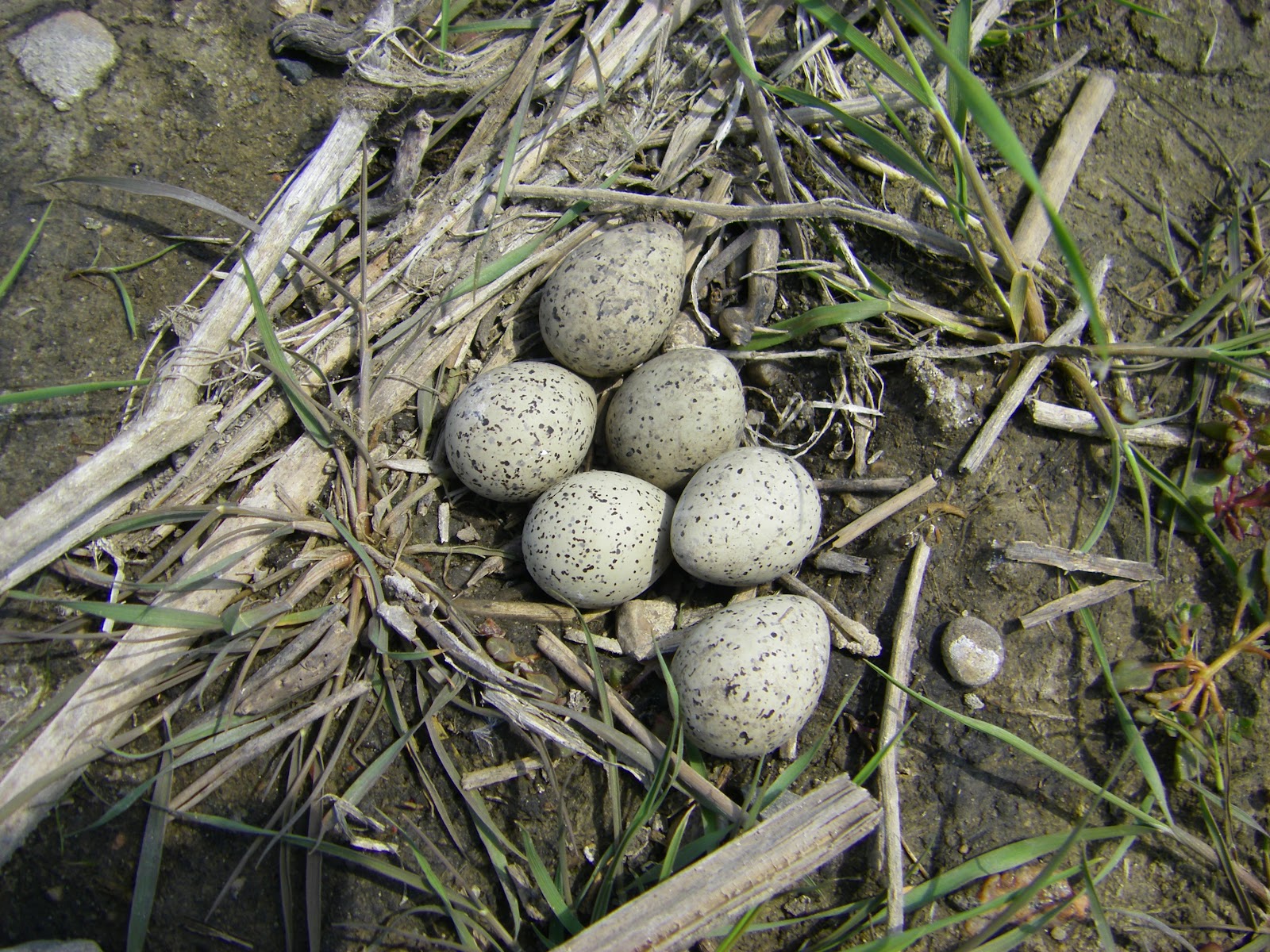
When placing the exclosure, we always want to take as little time as possible, so as not to disturb the birds for an extended period of time. However, I was taken aback for a short time when I discovered six eggs in the nest and the top third of a shell from a seventh egg. Four eggs is a normal clutch size. Don't ask me, "What's with that?" because I don't know. You will note in the photograph below that the top two eggs are slightly discoloured and darker that the other four. I will endeavour to find out what the possibilities are from a colleague in Saskatchewan and will report back. Although the nest looked a little in disarray, when I left this afternoon, both adult birds were trading off to incubate the eggs.

So there you have it; nothing at Grand Beach, but a nest in an area that's not seen plover activity in sometime. We will continue to monitor the situation on the East side of Lake Winnipeg and will be paying particular attention to the nest with six eggs. Stay tuned.

KP

Piping Plover nest with 6 eggs - Photo by Ken Porteous

16 May 2012

The Adventures of Mr. Black

Mr. Black by Jean Carpenter


On July 10, 2009, Paul Goossen of the Canadian Wildlife Service applied a black band to the upper left leg of a piping plover chick and Mr. Black's adventure began. This chick was one of five, from two nests banded at Grand Beach Provincial Park in Manitoba, Canada. Grand Beach is a tourist mecca located on the Southeast shoreline in the South basin of Lake Winnipeg. Paul fastened a Red over Black bicolour band on its lower right leg. This would distinguish it as a bird from Grand Beach. A metal band was attached to its upper right leg, but that solid black band would cement its moniker. Some time in the middle of August, Mr. Black made his approximate 2500 km maiden flight, as the plover flies, to his wintering grounds on the Gulf Coast of the United States.

On June 3, 2010, a plover guardian took four photographs of a piping plover with a band combination unfamiliar to anyone in the surrounding area. The pics were taken on a beach on the South shore of Lake Superior near Grand Marais, Michigan. And there for all to see was the black band on the upper left leg. Mr. Black was back baby! He had flown 1500 km north from the Gulf Coast, but had decided against taking the 800 km leg of his journey back to his ancestral home at Grand Beach. He had managed to battle his way through tornadoes, wind farms and tall buildings, not to mention his natural predators, to complete his first full migration.

On May 18, 2011, yes, you guessed it, Mr. Black returned again from his winter vacation on the Gulf Coast. However, this time he turned up at Port Inland, on Michigan's Upper Peninsula, about 100 km south of Grand Marais and on the North shore of Lake Michigan. And this time he had a mate! Unfortunately, when his mate had not returned for two days it was decided to pull the eggs into a captive rearing program. This would give Mr. Black a chance to re-nest, and re-nest he did with a Great Lakes female. A full clutch of four eggs were observed June 23. Doing the math it was determined the hatch date would be July 20. However, on July 21 no chicks could be found and no eggs remained in the nest. The prime suspect in this tragedy was a red fox as they had been seen in the area previously. To add insult to injury none of the eggs hatched in captivity. Now the question was, could Mr. Black endure the travails of another migration? He had done it twice before and survived vicious weather, tall buildings, telecommunication towers and even the Deepwater Horizon oil spill. Could he do it again?

I am ecstatic to tell you that Mr. Black has done it again. He's made it back to Port Inland and he's in love! On May 15, he was observed with a female that had a brood combination indicating that she hatched in 2009 on North Manitou Island in Lake Michigan, part of Sleeping Bear Dunes National Lakeshore. No nest yet, but monitors (guardians) expect to discover one any day now.

Stay tuned, for Mr. Black, the adventure continues.


KP

09 May 2012

Another Season Begins

Hello and welcome to the 2012 Peep-lo blog. My first post last year asked some questions. A year later, let me try to give you some short answers.

I have not seen any results of the Deepwater Horizon oil spill study, however of the nine plovers we identified last year across the province three of them were banded as part of the study. Each of these birds had a green flag band on their upper left leg indicating they were banded along the Gulf Coast as part of the study. One mated with an unbanded female, but went missing on June 22, 2011.

Although the 'Weather Bomb' of October 2010 did not adversely effect the ability of plovers to nest at Grand Beach, extreme high water levels around the South basins of Lake Winnipeg and Lake Manitoba did reduce available nesting habitat. It was nearly non-existent around Lake Manitoba.

It appeared that one, possibly two out of the three chicks we banded in 2010 returned. However, as the band combinations were incomplete, i.e. a band was modified or missing, we cannot be 100% sure that they were the ones banded at Grand Beach in 2010.

The chick that we banded in 2009 and that turned up on a beach near Grand Marais, Michigan in 2010 turned up last year about 100 kilometres south of Grand Marais near Port Inland, Michigan. I will write more on the adventures of Mr. Black in a future post.

Although results of last year's international piping plover breeding census are still being compiled, it appears for certain that numbers across Canada's prairies, of which we are considered part, will be down. Under the strict protocol of the survey conducted June 4-17, 2011, the final report will show that only one pair of plovers nested and were counted in Manitoba. However, we are confident that we identified nine different birds over the complete spring/summer season.

So far this year water levels are down exposing some prime nesting habitat. However, my colleague and I have identified only one piping plover to date. Although they should be back, it is still early so hopefully reports will filter in over the next few weeks. If in your travels you identify a piping plover or discover a nest, the Recovery Team would like to hear about it immediately. Please call the Manitoba Piping Plover Stewardship Program at 204-945-6817. Thank you.

Grand Beach - photo Ken Porteous

Best regards,
Ken Porteous
Recovery Program Coordinator