Piping Plovers are small, endangered shorebirds in Manitoba. Its call is described as a "plaintive peep-lo" which made it the perfect name for this blog as it too is a plaintive call, a Call to Action.

19 August 2012

So what happened to the nest of 7

Well, we're not 100% sure, but here's what we know and what transpired.

We were confident the nest would hatch out sometime in the last week of June so I made preparations to be there at that time.

June 23, Saturday evening - My colleague Alex visited the nest site. At 6:44 PM I received a text from her that said, "Just saw both plovers and checked nest. 5 eggs in the centre of nest, 2 looked to be pushed off to the side a bit."

June 26, Tuesday late afternoon and evening - I set up my spotting scope on the gravel road running adjacent to the ditch and island where the nest was located. From this vantage point, I observed both adult piping plovers. I could only see the top of the cage (exclosure) I had placed over the nest as the vegetation surrounding it had grown to a height of nearly 40 centimetres. I also saw two adult killdeers with a family of four. I estimated the chicks to be eight to ten days old. They were feeding on the far southwest shore of the island near to where the plover nest was located. Anytime the piping plovers got too close to the killdeer chicks the adult killdeers acted most aggressively towards them. They eventually drove them from the island. I watched them fly off in a southerly direction and land on another flooded field. During this time I also observed on the opposite side of the road a raven being buzzed by avocets, blackbirds and a lone eastern kingbird. It was walking in tall grass with its bill gaping open. Eventually, it picked up a large egg of some kind and flew off in the direction of a farmstead with blackbirds in hot pursuit.

As sunset approached, the piping plover pair returned to the island and when I left for the day both adults and the killdeer family were all present and accounted for.

The Island looking west, Whitewater Lake
Photo by K. Porteous

June 27, Wednesday - Although I had planned on checking the nest first thing in the morning, a storm blew through so my friend Brad and I decided to try again later in the afternoon. Upon arriving at the site at about 3:00 PM, I met Ken De Smet, a wildlife biologist with Manitoba Conservation and the Chair of the Manitoba Piping Plover Recovery Program. He had just finished visiting the nest. He reported that there were only three eggs in the nest and with no adults about, it appeared the nest and area had been abandoned.

Three eggs in exclosure - Photo by K. Porteous

June 28, Thursday morning - My friend Brad and I arrived at the plover site early. As we prepared to canoe across the ditch to the island to check on the nest, we observed a female northern harrier (hawk) skimming and hovering only a few feet above the vegetation on the island. She appeared to be very intent on capturing something, but flew off when she caught sight of us on the gravel road. After a short visit to the nest, I sent a text to Alex which read, "Only three eggs in nest. All cold. No chicks, alive or dead, no eggshells, no adults. Only 2 of 4 killdeer chicks left and get this, they swam across the ditch to get away from me! Not sure what happened to the other 4 plover eggs."

Whitewater Lake nest & exclosure looking east
Photo by K. Porteous

Those are the facts. That is what I and my colleagues observed over a six day period. So what happened? I'm afraid I don't know and only have more questions, than answers.

It would appear that four of the seven eggs hatched. This could have been the second clutch of eggs of a re-nest using the original nest site. I'm confident they were not predated as all seven eggs should have been taken and eaten if that was the case. But why were no chicks observed? Could the raven and/or the northern harrier have taken all of them along with two of the four killdeer chicks? As Brad, an accomplished outdoorsman and part-time trapper observed, "Nature can be so cruel."

I'm hoping the outcome was more positive. Having seen the killdeer chicks swim across the ditch, could the adult piping plovers, sensing there was only room for one set of chicks on the island, cajoled their chicks to swim across the water to a safer shoreline away from the island and killdeers. We will never know for sure, but we can hope that that's what happened. We can hope that at least four of the nest of seven survived and are now headed south to the Gulf.
KP

17 June 2012

And Then There Were Seven

I drove to Southwestern Manitoba on Friday, June 15, to check on the plover nest I had exclosed 15 days earlier. And this story just gets more bizarre. Yesterday morning, June 16, a friend helped me to the island in his canoe. It had rained all night and the morning was cool and blustery. Once on the island, both adult piping plovers greeted me immediately. Judging from the picture below you'd think I was on one of the 'Big' lakes where they have traditionally nested.

Female & male piping plover - photo by K. Porteous

However, that's not the case here. These birds have nested on an island created in a farmer's flooded field. The day before was idyllic with a 'Simpsons' sky.

Plover Island in Southwestern Manitoba - photo by K. Porteous

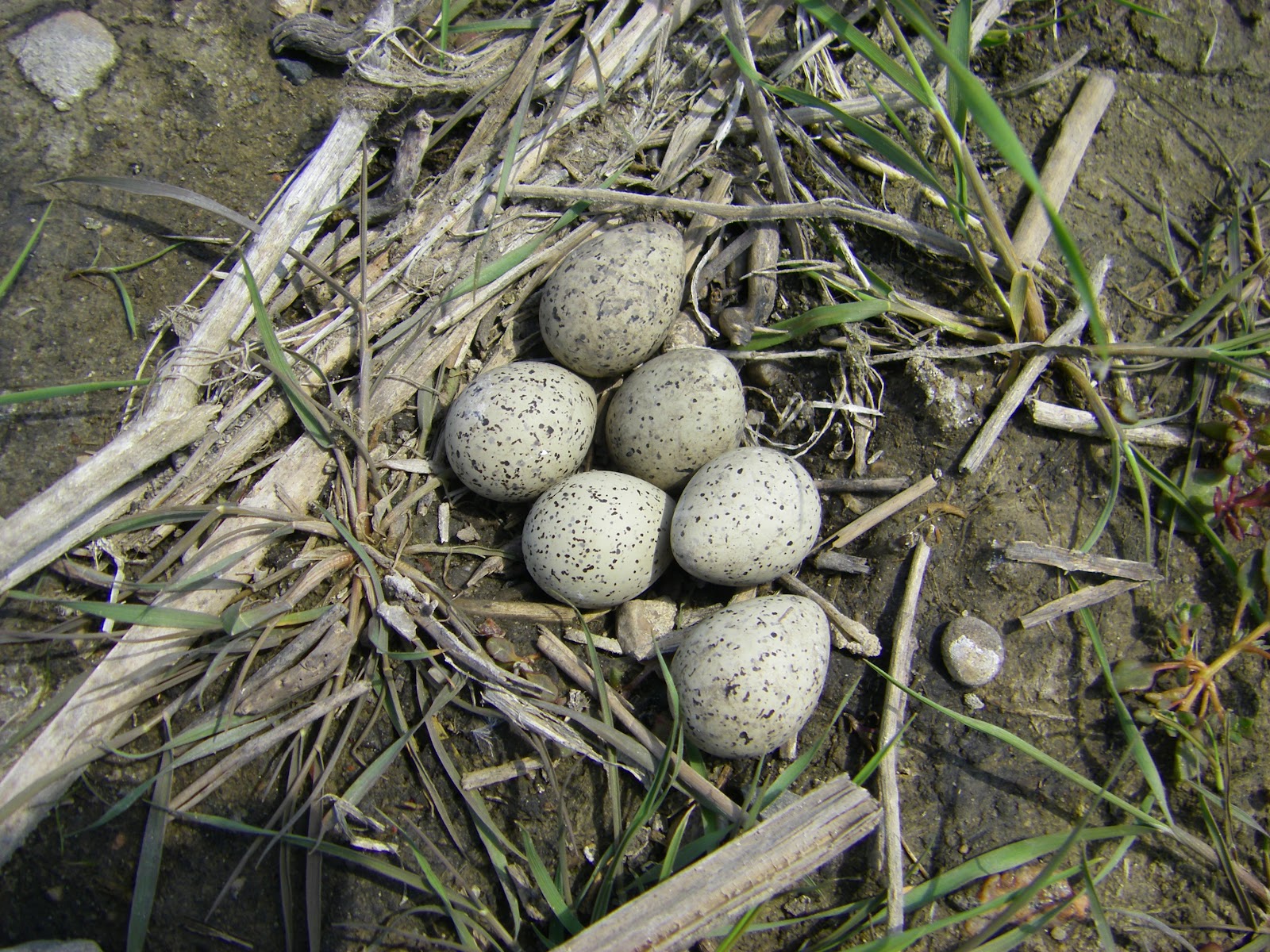
Once on the island I made a beeline to the nest so as not to disturb them and their shorebird neighbours, the American avocets, for any longer then required. Once again, I was slack-jawed when I saw the nest. It now had seven eggs in it! And the nest is like no other piping plover nest I have ever seen. It is surrounded by vegetation and the scrape is not lined with pebbles. For that matter, there is no sand/gravel substrate at all, just wet ground.

A friend and colleague of mine in Saskatchewan and an expert on shorebirds provided me with a couple of plausible explanations for why seven eggs and not the normal clutch of four. It is possible that two females are laying in the same scrape. Although I was only on the island for five minutes, I did make a thorough check of the shoreline looking for a second female, but only saw the pair. A second possibility is that the female laid a complete clutch, but one or two were predated and then she laid another lot of four in the same nest. However, as my friend said in her email, "It would have to be an awfully stupid bird!" But as I said earlier, this whole situation has been bizarre from the outset. We haven't had a nest reported in this area in years, the nest is not your typical piping plover nest and it has seven eggs in it. Crazy!

By my calculations, the nest should hatch out some time during the last week of June. Stay tuned.

Exclosure over nest, note veg - photo by K. Porteous

Count them, seven eggs!
Note, no scrape, wet ground - photo by K. Porteous
KP

01 June 2012

The Season to Date

It is with a heavy heart that I must inform everyone that for the first time that I can remember, we have not found a nest on the East side of Lake Winnipeg and in particular Grand Beach. We have observed single birds on four different occasions at four different locations; Grand Marais, Beaconia Beach, Hillside Beach and parking lot #5 at Grand Beach. Are they four different birds or is it the same bird searching different areas for a mate? We'll never no for sure as none of the birds observed to date has been banded.

However, with the discouraging news comes some positive news. A nest was found and confirmed on Tuesday located in Southwestern Manitoba; the first such observation in many years. It is located on a small island shared with about 40 American avocets in a flooded farmer's field. Go figure. I was able to place an exclosure over the nest today to help protect the eggs from marauding raccoons, foxes and crows.

When placing the exclosure, we always want to take as little time as possible, so as not to disturb the birds for an extended period of time. However, I was taken aback for a short time when I discovered six eggs in the nest and the top third of a shell from a seventh egg. Four eggs is a normal clutch size. Don't ask me, "What's with that?" because I don't know. You will note in the photograph below that the top two eggs are slightly discoloured and darker that the other four. I will endeavour to find out what the possibilities are from a colleague in Saskatchewan and will report back. Although the nest looked a little in disarray, when I left this afternoon, both adult birds were trading off to incubate the eggs.

So there you have it; nothing at Grand Beach, but a nest in an area that's not seen plover activity in sometime. We will continue to monitor the situation on the East side of Lake Winnipeg and will be paying particular attention to the nest with six eggs. Stay tuned.

KP

Piping Plover nest with 6 eggs - Photo by Ken Porteous

16 May 2012

The Adventures of Mr. Black

Mr. Black by Jean Carpenter


On July 10, 2009, Paul Goossen of the Canadian Wildlife Service applied a black band to the upper left leg of a piping plover chick and Mr. Black's adventure began. This chick was one of five, from two nests banded at Grand Beach Provincial Park in Manitoba, Canada. Grand Beach is a tourist mecca located on the Southeast shoreline in the South basin of Lake Winnipeg. Paul fastened a Red over Black bicolour band on its lower right leg. This would distinguish it as a bird from Grand Beach. A metal band was attached to its upper right leg, but that solid black band would cement its moniker. Some time in the middle of August, Mr. Black made his approximate 2500 km maiden flight, as the plover flies, to his wintering grounds on the Gulf Coast of the United States.

On June 3, 2010, a plover guardian took four photographs of a piping plover with a band combination unfamiliar to anyone in the surrounding area. The pics were taken on a beach on the South shore of Lake Superior near Grand Marais, Michigan. And there for all to see was the black band on the upper left leg. Mr. Black was back baby! He had flown 1500 km north from the Gulf Coast, but had decided against taking the 800 km leg of his journey back to his ancestral home at Grand Beach. He had managed to battle his way through tornadoes, wind farms and tall buildings, not to mention his natural predators, to complete his first full migration.

On May 18, 2011, yes, you guessed it, Mr. Black returned again from his winter vacation on the Gulf Coast. However, this time he turned up at Port Inland, on Michigan's Upper Peninsula, about 100 km south of Grand Marais and on the North shore of Lake Michigan. And this time he had a mate! Unfortunately, when his mate had not returned for two days it was decided to pull the eggs into a captive rearing program. This would give Mr. Black a chance to re-nest, and re-nest he did with a Great Lakes female. A full clutch of four eggs were observed June 23. Doing the math it was determined the hatch date would be July 20. However, on July 21 no chicks could be found and no eggs remained in the nest. The prime suspect in this tragedy was a red fox as they had been seen in the area previously. To add insult to injury none of the eggs hatched in captivity. Now the question was, could Mr. Black endure the travails of another migration? He had done it twice before and survived vicious weather, tall buildings, telecommunication towers and even the Deepwater Horizon oil spill. Could he do it again?

I am ecstatic to tell you that Mr. Black has done it again. He's made it back to Port Inland and he's in love! On May 15, he was observed with a female that had a brood combination indicating that she hatched in 2009 on North Manitou Island in Lake Michigan, part of Sleeping Bear Dunes National Lakeshore. No nest yet, but monitors (guardians) expect to discover one any day now.

Stay tuned, for Mr. Black, the adventure continues.


KP

09 May 2012

Another Season Begins

Hello and welcome to the 2012 Peep-lo blog. My first post last year asked some questions. A year later, let me try to give you some short answers.

I have not seen any results of the Deepwater Horizon oil spill study, however of the nine plovers we identified last year across the province three of them were banded as part of the study. Each of these birds had a green flag band on their upper left leg indicating they were banded along the Gulf Coast as part of the study. One mated with an unbanded female, but went missing on June 22, 2011.

Although the 'Weather Bomb' of October 2010 did not adversely effect the ability of plovers to nest at Grand Beach, extreme high water levels around the South basins of Lake Winnipeg and Lake Manitoba did reduce available nesting habitat. It was nearly non-existent around Lake Manitoba.

It appeared that one, possibly two out of the three chicks we banded in 2010 returned. However, as the band combinations were incomplete, i.e. a band was modified or missing, we cannot be 100% sure that they were the ones banded at Grand Beach in 2010.

The chick that we banded in 2009 and that turned up on a beach near Grand Marais, Michigan in 2010 turned up last year about 100 kilometres south of Grand Marais near Port Inland, Michigan. I will write more on the adventures of Mr. Black in a future post.

Although results of last year's international piping plover breeding census are still being compiled, it appears for certain that numbers across Canada's prairies, of which we are considered part, will be down. Under the strict protocol of the survey conducted June 4-17, 2011, the final report will show that only one pair of plovers nested and were counted in Manitoba. However, we are confident that we identified nine different birds over the complete spring/summer season.

So far this year water levels are down exposing some prime nesting habitat. However, my colleague and I have identified only one piping plover to date. Although they should be back, it is still early so hopefully reports will filter in over the next few weeks. If in your travels you identify a piping plover or discover a nest, the Recovery Team would like to hear about it immediately. Please call the Manitoba Piping Plover Stewardship Program at 204-945-6817. Thank you.

Grand Beach - photo Ken Porteous

Best regards,
Ken Porteous
Recovery Program Coordinator

02 July 2011

Black Friday

My first day back on the East side of Lake Winnipeg started on a high. I arrived for an evening shift on Monday, June 20. Three of the four eggs of the only nest found in Manitoba this year had hatched out and the tiny chicks were already mobile. The following day, I arrived for the morning shift at 4:30 AM. I found the male about a meter from the nest and it was obvious the chicks were nestled under him. But was it three or four. I could not see the fourth egg in the nest, but it was difficult to observe even with binoculars. It would be mid-morning before I was finally able to count, 1 - 2 - 3 - 4 chicks. All four eggs had hatched successfully.


I had the late shift Wednesday - 12:30 - 9:30 PM. I met my colleagues and was informed that although the chicks were doing fine, the male was AWOL. This was unusual and disconcerting. Normally, after about a week the female plover leaves the family and the male is left to tend to their needs and protect them. By the end of the day the male had not returned. I had seen a Goshawk glide over the parking lot earlier in the day. Had the male plover been picked off by this hawk or come to some other dire outcome or had he taken off with another female we had seen frequenting the area? We were at a loss to explain his disappearance.


Thursday was uneventful. I had the early morning shift and one of my colleagues the late shift. The report at 9:30 PM was that although the male was still AWOL, the female and chicks had had a good day mainly feeding and preening and all were present and accounted for when she left.


I had the early morning shift on Friday, June 24. At 4:54 AM I wrote in my notes, "Took me a while to find mom, but finally found her nearly exactly where she was yesterday morning, just north of the nest enclosure fence. She peeped and I left immediately without disturbing her off her chicks. Will count later." About an hour later I observed one chick leave the confines of the female and waited anxiously to count the others. Except there were no others to count. The female raised up and began to walk and to my horror there were no other chicks. I was gutted.


Some time between 9:30 PM the previous evening and 4:30 AM Friday morning, under the cover of darkness, something had taken three of the four chicks. The likely suspects are nocturnal mammals like a raccoon, skunk or fox although none had been seen recently in the area. However, a crow had been hanging around the vicinity and although would have roosted at night perhaps in the post-dusk light of evening or pre-dawn light of morning could have attacked the family. With only one adult present to fend off the attacker she was only able to save one chick. Such is Nature's way.


One can only imagine how Friday morning's tragedy played out had a raccoon happened upon the female and chicks. She would have remained perfectly still with the chicks beneath her. Her camouflage would have made her blend in perfectly with her surroundings of sand and rock. But once detected as something more than a rock, she would have had the chicks scatter and she would have done everything in her power to lead the raccoon away, feigning a broken wing and peeping nearly hysterically. The raccoon would have had nothing to do with it. She would have buzzed the intruder, as it gobbled down one of the young and went for a second. She would have continued the good fight, but a second chick would by now have been snatched. The only thing left to do would have been to sacrifice the third chick and lead the fourth chick as far away from the intruder as possible and hope the intruder would not follow.


In the end the female saved one chick. For me and my colleagues on the Piping Plover Recovery Team it was indeed a Black Friday.
KP

28 June 2011

High Water Hurts Plovers

Go to the following link for an article in the most recent edition of the Interlake Spectator.
http://www.interlakespectator.com/ArticleDisplay.aspx?e=3171586
KP

07 June 2011

World Birding Hotspot

Over the years, as I have traveled the Interlake from the West shore of Lake Winnipeg to the East shore of Lake Manitoba and back, I've often wondered how cool it would be to designate this area as a World Birding Hotspot or WBH. The diversity of birdlife I see in my travels never ceases to amaze me and it never gets old. Whether it's white pelicans gliding overhead, great egrets along the Shoal Lakes, ducks in the marshes or the myriad number of colourful songbirds, like the Baltimore oriole, eastern bluebird, goldfinch or red-headed woodpecker, it's a stunning spectacle.

I would love to see our provincial road map from the North perimeter highway, north to PTH 68, east to Lake Winnipeg and west to Lake Manitoba shaded in some colour to make it distinctive with World Birding Hotspot emblazoned in large bold type across the area. The designation would be strictly for promotion purposes, it would have no legal status. Those land owners lucky enough to live within its boundaries and know how special the area is would not have to worry about any type of government intervention or expropriation. It would simply be a way of telling the world what an incredible area the Interlake is for birdlife and there would be many more spillover benefits. These would include; increased economic tourism expenditures, improvements to existing infrastructure and the overall pride generated when one is part of something special.

In future, the Southwest corner of the province and the Churchill area could also be designated WBH's and appropriately shaded on the provincial road map. Let's face it, birding and its related industries is the single largest recreational activity in the world today and generates monetary benefits in the billions of dollars world-wide.

I'd be interested to know what you think of this idea. Does the idea have merit or have I been in the sun too long? Let me know.
KP

02 June 2011

2011 International Piping Plover Breeding Census

This year marks the fifth count of piping plovers across North America since 1991. The census is conducted every five years and will run this year from June 4-17. In 2006, about 8,100 birds were counted, up from 2001. However, the debate continued from previous counts as to whether the increase was due to management efforts in the field or the census was simply more thorough and birds were found at sites previously not visited during other censuses.


However, no matter the reason, 8,100 birds is a critically low number as far as bird counts are concerned. Unfortunately, in Manitoba, our expectations for a sudden increase in numbers is low. The Manitoba population as decreased every census, from 80 in 1991 to 60 in 1996 to only 16 in 2001 and finally eight in 2006. Last year, a non-census year, we counted only seven plovers. This year, five different birds were identified during the second week of May and we've had no further reports. Now one might argue that Manitoba is a huge province and surely you have not been everywhere and seen every bird. And it's hard to argue against that logic. However, we have a pretty good idea of where to look for these birds. They stake out territories and build nests on wide, flat beaches around the South basins of Lake Winnipeg and Lake Manitoba. Also, Manitoba has a very active birding community. According to the Manitobabirds group web site, they have 469 active members and post their sightings daily. No one from this group has contacted me with a sighting or posted a sighting.


So why the low numbers? We have been in a high water cycle for nearly 20 years. High water has reduced nesting habitat significantly. West Shoal Lake which accommodated the highest concentration of plovers in the province has been flooded for at least the past 10 years. Coupled with human disturbance of nesting areas and predation from other birds like crows and ravens and mammals like fox, raccoons, coyotes and skunks, well it's no wonder why our plover population has declined.


However, it is not all doom and gloom. Through intensive management efforts, we have had 42 chicks fledge (able to fly on their own) in the past five years. That is well above the success rate biologists have deemed required to sustain a population of piping plovers. And, some of the chicks we have banded over the past two years are showing up near to the areas where they hatched out and we've even had a report of one of our banded birds turning up in Grand Marais, Michigan. So there is hope. I believe that if we can maintain a population in Manitoba, however small it may be, that once the high water cycle ends and nesting habitat is again exposed, our dwindling population will begin to slowly increase. Time is on our side. Now if precipitation and water levels could get back to normal, we'd be on our way.


I should have preliminary census results by the third week of June and will report back at that time.
KP

25 May 2011

Plovers Banded as part of Gulf Oil Spill Study

Plover banded on Gulf Coast winter range
photo credit: Sidney Maddock
As part of a study into the effects of last year's Gulf Oil Spill, some piping plovers were marked on their winter range. One of the key bands was a green flag or tab band located on the left leg high as shown in the photo above.

Two of the three banded birds identified at Grand Beach have the green flags. This leads us to believe that they may be part of the Gulf Oil Spill study. Plover #1 was marked like this: left high - green flag, left low - black, right high - yellow, right low - black. Plover #2 was marked: left high - green flag, left low - red, right high - yellow, right low - black. We have sent this information to the study co-ordinator and hope to receive some feedback in due course. As soon as information becomes available I will let you know. Stay tuned.
KP

23 May 2011

What have the bands told us so far?

In my last post, I had good news, bad news. The bad news was that we had identified only five piping plovers province-wide. The good news was four of the five had been banded.

Let's look at two of them in this post. The bands on the plover identified at Hillside Beach were read like this: left high - neon green, left low - no band, right high - metal, right low - red. The metal band is the key to where and when this plover chick was banded. However, you would need to either capture this bird, a risky undertaking, or have the bird observed closely through a powerful spotting scope so the band number could be read. As neither was done, we have to use the colour combinations in an effort to determine where and when these birds were banded.

Back in 2009, we banded five chicks at Grand Beach and three at Gimli. Last year, we banded three chicks at Grand Beach. Now back to the Hillside bird. Birds banded at Grand Beach were given a bicolour band, red over black, right low and the Gimli birds were black over red, right low. The tricky thing about the Hillside bird is that to make the bicolour bands we wrapped half a red band with special black tape used in pin-striping automobiles. That tape over a two year period may have worked itself free and now the band only shows red. Confused? Stay with me. Of the 11 plovers we banded, two were given neon (light) green bands, left high; one at Grand Beach, the other at Gimli.

So to summarize, we are fairly certain the Hillside bird was one of ours, but it could have been banded either in 2009 at Gimli or last year at Grand Beach. The only way we will no for sure is if we see it again and have an opportunity to read its metal band.

The bands on one of the plovers identified at Grand Beach were read like this: left high - no band, left low - no band, right high - metal, right low - red over black (bicolour). What does this tell us? Almost assuredly, this is one of the birds we banded at Grand Beach in either 2009 or 2010. Because it appears the band, left high has been lost, we have no way of telling if this plover was one of the chicks banded from a nest by the channel at Grand Beach or is the one chick we banded in 2009 from a nest in parking lot #5 at Grand Beach.

Our top sleuths are on the case and the investigation continues. I'll discuss the other two banded birds in my next post.

KP

18 May 2011

East-side 5 West-side 0

No, this is not the score in some obscure hockey league play-off game. Unfortunately, it paints a rather bleak picture of the number of piping plovers identified so far around the province. On the East-side of Lake Winnipeg my colleagues have seen four plovers at Grand Beach and one at Hillside Beach. On the other side of the 'Big" lake I have been skunked and that goes for the East-side of Lake Manitoba too. I have surveyed Gimli Beach on several occasions, Willow Island a couple of times and Dunnottar Beach, Winnipeg Beach and the Riverton Sandy Bar once each. On Lake Manitoba, I have visited north to south, Watchorn Beach, Lundar Beach, Twin Lakes Beach, St. Ambroise Beach and I was stymied trying to reach the Clandeboye Bay Special Conservation Area due to high water. Of course high water on Manitoba's 'Great Lakes' has plagued us for a number of years now. It shrinks the available habitat for plovers and they either move on or nest unsuccessfully. However, the numbers are not all doom and gloom. Of the five plovers identified on the East-side, four of them were banded birds. We are still determining where and when they were banded. More on that subject to come.

KP

08 May 2011

First Plovers Spotted

Grand Beach Channel looking west from East Beach
The first piping plovers have arrived. My colleagues Shauna and Maha identified two near the channel that separates west and east beaches at Grand Beach Provincial Park. They were seen Thursday, May 5. Interestingly, the first plovers sighted last year was on May 4 and yet the weather last year was completely different from this year. Last year, the ice on the lake was gone by mid-April, while this year large portions of the lake still have drifting ice. However, for the plovers, this is when they arrive, first week of May, no matter what the weather or ice conditions. Here's hoping I'll have similar luck on the west side of the 'Big' lake this coming week. Stay tuned.

KP

07 May 2011

The Eagle Has Landed


"Eagle" on the beach in Gimli
 I began my plover surveys this week. On Tuesday, May 3, I visited Gimli Beach and was surprised to see a Bald Eagle sitting on a post in the middle of the beach. As I approached closer and closer it did not move. Very strange. Finally, I walked right up to it and realized it was not real. It was plastic and nailed to its perch. As if there were not enough problems for piping plovers trying to nest at Gimli Beach, now they had to contend with a menacing looking Bald Eagle. I needed to investigate what was going on.

As it turned out, the eagle had been placed on the beach last fall by staff of the RM of Gimli. It is an attempt to scare off gulls as a measure intended to reduce the incidence of e-coli in the lake adjacent to the beach. It would be hard to argue against this measure, but will it also scare away our plovers? After discussions with two bird biologists my mind was set at ease. Apparently, these types of attempts work initially, but as one biologist put it, "Birds learn pretty quickly what is real & what is not." So the mystery of the plastic eagle nailed to its perch has been solved. Hopefully, it will not deter any of our endangered piping plovers from making a nesting attempt on Gimli Beach as they did in 2009.

KP

26 April 2011

So Many Questions, So Few Answers

Hello to all my fellow plover-lovers out there. I wanted to let everyone know that I will be returning as a Guardian this summer. Through this blog, I hope to keep you informed on how our birds do this season. As I am a little more familiar with the ins and outs of blogging, I hope to keep you up to speed in a timely manner. It is also my intention to post a few more photos and video clips this summer.

The plovers are only a week or two away from arrival and we have many unanswered questions. Did last year's Gulf Coast oil spill have any effect on the wintering range of the plovers? How has last fall's devastating storm or 'Weather Bomb' effected the beaches and nesting habitat for our returning birds? Will any of the three chicks we banded last July, return? Will any of the eight we banded in 2009 return and will the one that showed up in Grand Marais, Michigan last year return there or turn up elsewhere? As this is an 'International Census' year, conducted every fifth year since 1991, will the North American population be up, down or about the same as 2006? The answers to all these questions should come to light over the course of the summer and I hope to bring you those answers as soon as they become evident and available.

Last, if in your travels and explorations you identify a plover or discover a nest, the Recovery Team would like to be informed immediately. Please call the Manitoba Piping Plover Stewardship Program at 204-945-6817. Thank you.

Ken Porteous
2011 Piping Plover Guardian

30 July 2010

Airborne

The three channel chicks took their maiden flights on Friday, July 23. They continued to practise their new found freedom for the rest of the day. Later in the evening, I witnessed an amazing scene not once, but twice and recorded it in my notes this way; "Dad left the fenced enclosure and gradually made his way to the slight rise of beach-ridge in front of the water. One by one the chicks slipped between the slats of the snowfence and with a running start got airborne and flew to papa." As if to reward his charges, dad let the young ones feed for about 20 minutes before taking them back to the enclosure to do the test flights all over again.

With the channel chicks fledged, that brought our total to seven at Grand Beach this year. That is up two from last year, but down one over-all. Last year five chicks fledged at Grand Beach from two nests while a nest across the lake at Gimli fledged three birds for a total of eight.

The question now, is, how will they fair on their flight south to their wintering grounds along the Gulf of Mexico and how will the oil spill effect them? We won't find out the answer to that question until their return nine months from now in May 2011. We're keeping our fingers crossed.

KP

28 July 2010

SWAT Team Moves In

Last Wednesday, July 21, Paul Goossen of the Canadian Wildlife Service arrived to band the three channel chicks. As the chicks were three weeks old and nearly ready to fly, it became quite the operation. With the precision of a SWAT team, armed only with butterfly nets, Paul, Morgan, Matt and I slowly herded the chicks towards the beach shoreline. Paul instructed us that once they attempted to break through our defence, the idea was to get the net in front of them and have them run into it; easier said then done. Paul, Morgan and Matt successfully captured two while I chased my target like a cheetah on a gazelle. Okay, maybe it was more like an out-of-shape old guy running after a puppy, but just when I thought I had him or her, she took off, as in flying, low to the ground and down the beach. I hiked back to my team, out of breath, where they took a few cheap shots at my unsuccessful effort.

On our next attempt, the chick again attempted to take flight, but this time landed in the water where we quickly scooped it up.

The chicks were each fitted with three bands. An aluminum one with a number on it would identify all the particulars of the who, when and where the bird was banded. The other two bands are coloured plastic. They can be seen with the naked eye if close enough or with the aid of binoculars or a spotting scope. This way information about the bird can be gathered without having to recapture it. One band is coloured, red over black. This identifies the bird as one banded at Grand Beach. The second is an individual colour. This identifies from which nest at Grand Beach the chick hatched. After 26 minutes Mr. Red, Mr. Orange and Mr. Light Green, or is that Ms, were back to what chicks do, feeding, resting and preening, although dad did take them for a bath as if he wanted to make sure they didn't catch any 'human cooties.'

KP

21 July 2010

My Error!

In my morning post, I informed everyone that one of our chicks, banded last year, had been observed and identified at Grand Marais, Minnesota. In fact, this bird was identified at Grand Marais, Michigan, on the south shore of Lake Superior. According to Google Maps this is a 15-hour - 1,262.6 km drive from Grand Beach, Manitoba. Grand Marais, Michigan is about a 2-hour drive from Sault Ste. Marie, Ontario. Does this mean more of our chicks ended up in the Great Lakes population this year, perhaps reaching as far north as Ontario? Stay tuned.

KP

Missing Chick Found


Back on June 2, I wrote a post about how the eight chicks we banded last year had not been seen anywhere from the Great Lakes to Alberta. Well, I am pleased to announce that one of the Grand Beach banded chicks has been spotted and identified at Grand Marais. Now I know most of you who have been following the blog and know the Grand Beach area are asking yourselves, why we didn't see it earlier, considering Grand Marais is a stones-throw from Grand Beach. The reason is this, wait for it, this Grand Marais is 800 km by vehicle (sorry, Google doesn't have a button labelled 'as the crow flies' I could click on) southeast of Grand Beach in Minnesota along the shores of Lake Superior about a two hour drive north of Duluth, Minnesota.

For Grand Beach 'Plover Lovers' this is terrific news!

...to be continued

photo - Jean Carpenter

KP

18 July 2010

Parking Lot Plovers Take Flight

At 11:47 AM, Saturday, July 17, I observed the four chicks, hatched from the enclosure in parking lot #5 at Grand Beach Provincial Park, take to the air and cross the water channel that separates West Beach from East Beach, a distance of about 50 metres. During the week, my colleagues and I had watched them take some short hops along the shoreline, even venturing out over the water a short distance before swinging back and landing. However, the channel crossing was momentous because there was no turning back. It was either make it to the other side or tumble into the strong current of the channel and be swept out into the big lake. They made it!

KP